
Water Rights
Texas Water Rights: Surface Water, Groundwater, and the Rule of Capture
Surface water, groundwater, wells, groundwater districts, the rule of capture, and severed water estates.
Read nowRead the Guide
Water rights, eminent domain, reservoirs, solar, data centers, and the development pressure reaching Texas land.
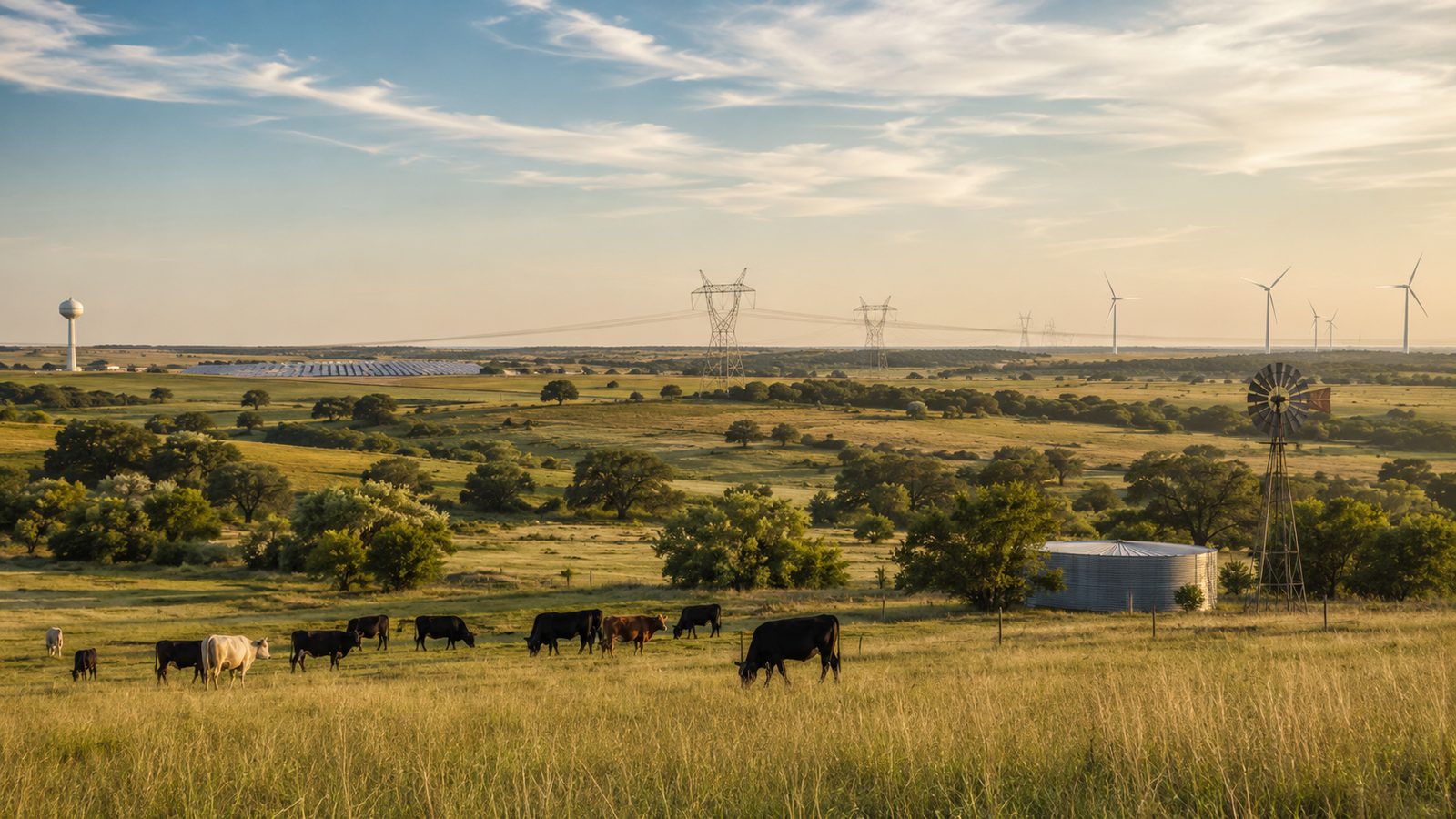
Texas land supports homes, farms, ranches, wildlife, water supplies, energy production, transportation, and a growing digital economy. As the state's population and industries grow, more of that growth is reaching land that has been in the same families for generations.
Development may bring investment, services, infrastructure, lease opportunities, construction activity, and tax revenue. It may also raise questions about water availability, easements, land conversion, public notice, compensation, infrastructure costs, environmental conditions, and future land use. The effect depends on the project's location, size, water source, technology, supporting infrastructure, permits, agreements, and local conditions.
The purpose of this Learning Center is not to tell Texans whether a particular project is good or bad. It is to help readers:
For many landowners, the first sign that a project is coming is not a news story. It is a document. A landowner's first contact may be:
The first document may not reveal the full project, and it does not establish that the project is inevitable. Projects can change routes, change scope, stall in permitting, lose financing, or never be built. At the same time, what a landowner signs early can shape everything that follows.
Identify:
The full landowner checklist below expands each of these into specific questions you can print and take to a meeting.
Phase One publishes the two water guides below. The remaining topics are in research and will follow — each card describes what the finished guide will cover.
Surface water, groundwater, wells, groundwater districts, the rule of capture, and severed water estates.
Water shortages, recommended strategies, reservoir maps, project sponsors, planning regions, and financing.
Conceptual maps, project stages, voluntary purchases, pipelines, mitigation land, and condemnation.
Public use, adequate compensation, offers, appraisals, special commissioners, objections, and court proceedings.
Survey access, route selection, permanent and temporary easements, restoration, and compensation.
Options, leases, access, drainage, agricultural use, taxes, assignment, decommissioning, and restoration.
Water, power, land, cooling systems, infrastructure, local benefits, project-specific impacts, and transparency.
Local agendas, agency dockets, permits, planning documents, hearings, and public-information requests.
Data centers vary significantly in size, computing purpose, cooling method, water source, water consumption, electricity demand, backup generation, land footprint, and supporting infrastructure. Two facilities that look alike from the road can have very different water and power profiles.
Potential benefits identified for host communities may include capital investment, construction activity, tax revenue, technology infrastructure, fiber expansion, supplier opportunities, workforce development, and reuse of industrial property. Potential questions may involve direct and indirect water use; whether the source is municipal water, groundwater, surface water, or reclaimed wastewater; cooling technology; electric generation and transmission infrastructure; backup generators and air permits; roads, traffic, noise, lighting, and drainage; tax incentives; long-term employment; infrastructure costs; effects on neighboring property; and decommissioning.
The Draft 2027 State Water Plan does not separately identify data centers as a statewide water-demand category. Some existing use may be included within municipal or industrial data, but the extent to which the draft captures rapidly proposed future data-center demand is not clearly shown. University of Texas researchers have estimated that data centers could account for roughly 3% to 9% of Texas water use by 2040 — a scenario range, not a guaranteed outcome, and one that depends on growth, location, cooling technology, water source, electricity source, reuse, reporting, and operations.
Viewpoint note: some public officials have published editorials proposing limits or pauses on hyperscale data-center development, including statements by the Texas Agriculture Commissioner. Those are policy proposals and viewpoints, not adopted Texas policy, and this site does not adopt them as its own editorial voice.
Not every company, utility, district, or governmental entity possesses condemnation authority. Legal authority must exist, the acquisition must meet applicable public-use requirements, and Texas law requires adequate compensation. Procedures may involve notices, appraisals, bona fide offers, special commissioners, objections, and court proceedings.
A private entity may sometimes possess delegated eminent-domain authority for qualifying public infrastructure. But a planning map does not itself commence condemnation, and negotiation and condemnation are different stages. Eminent domain does not permit government or industry to take any property for any reason — the full guide, coming soon, will walk through each stage and the Texas Attorney General's Landowner's Bill of Rights.
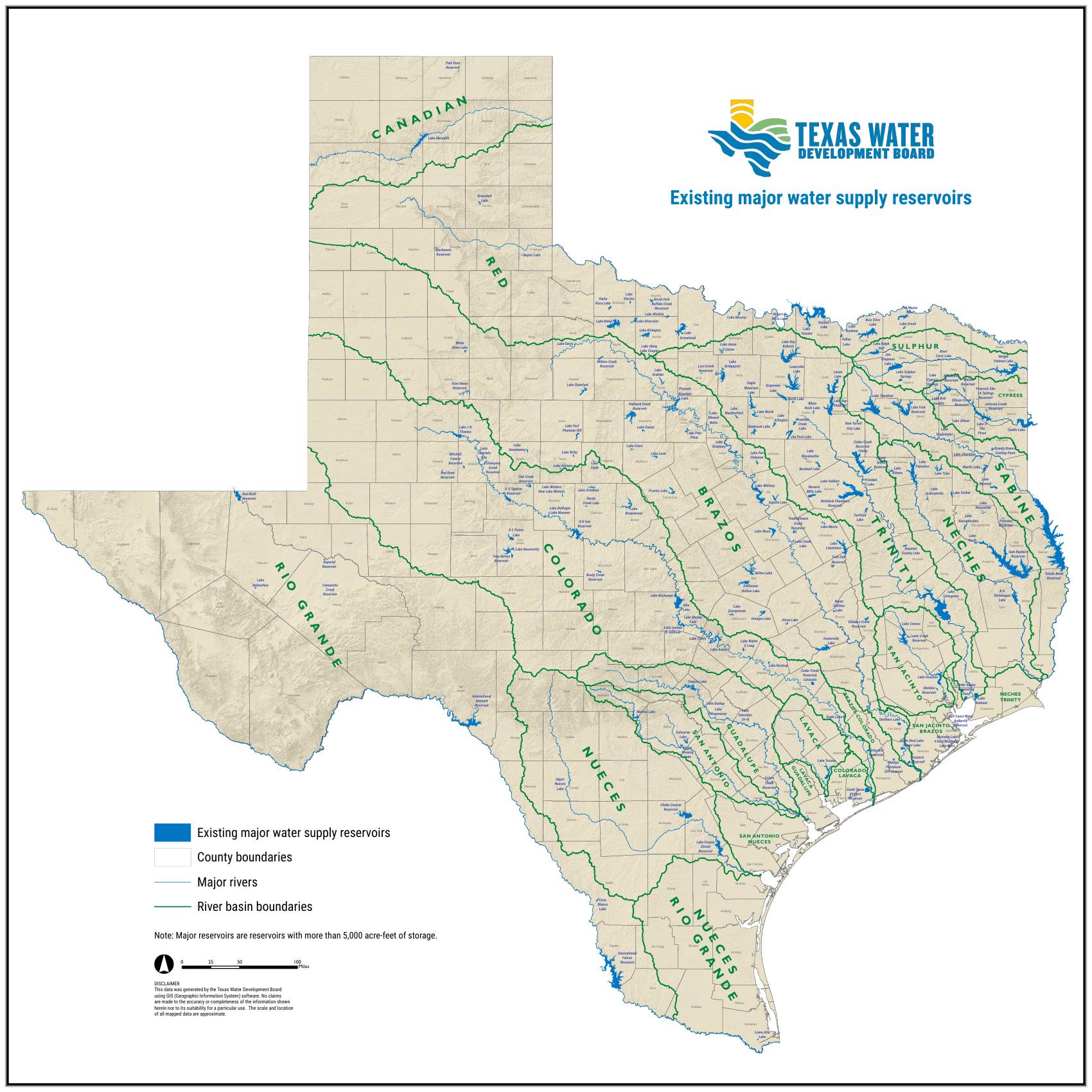
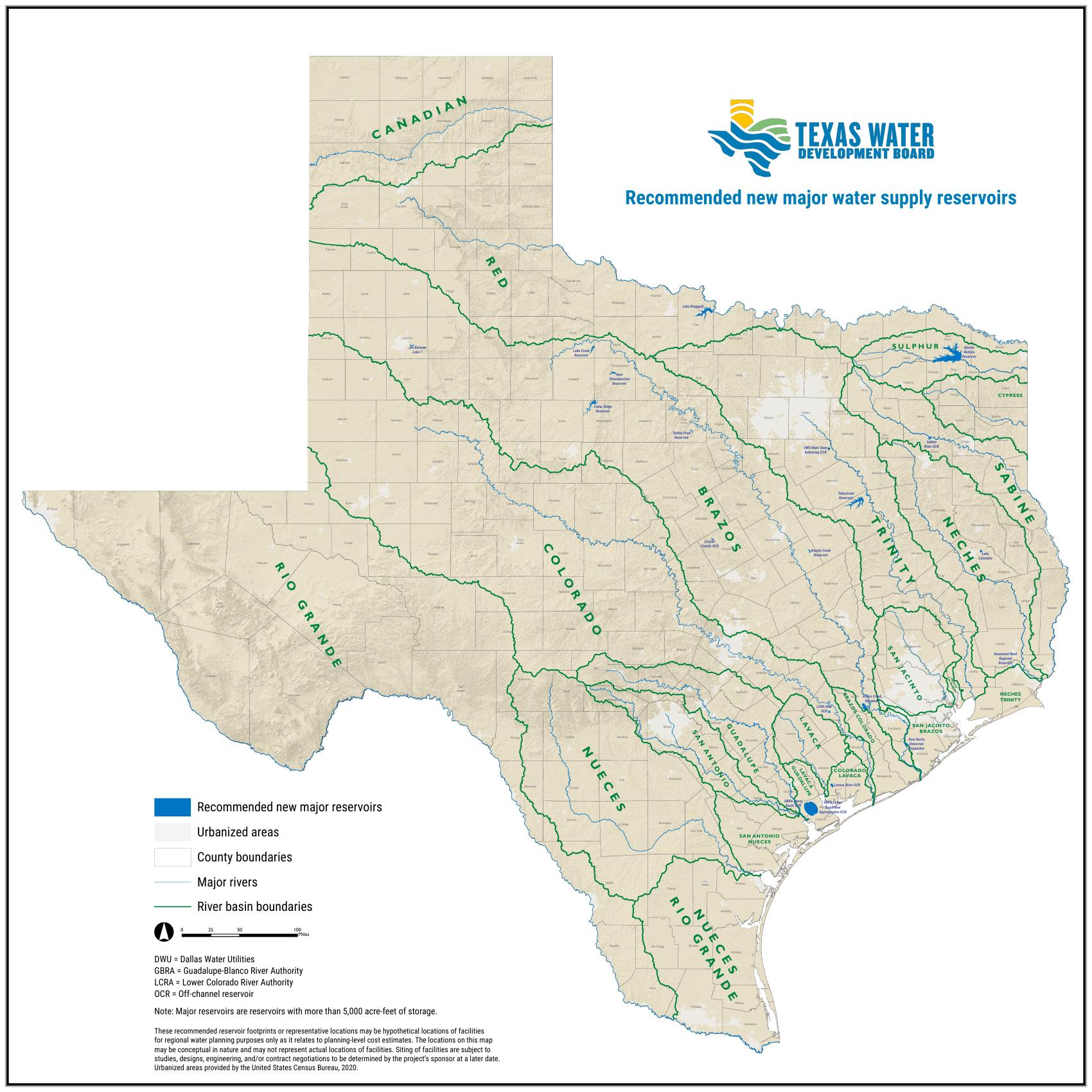
The maps below are official Texas Water Development Board documents, shown complete — title, legend, scale, notes, and disclaimer included. Open the full PDF for detail.
Inclusion does not mean that a project is fully approved, funded, permitted, or scheduled for construction. It does not establish that a particular parcel will be purchased or condemned.
Official Texas Water Development Board map of existing major water supply reservoirs — those with more than 5,000 acre-feet of storage.
Open PDF mapOfficial TWDB planning map of recommended new major reservoirs from the Draft 2027 State Water Plan. Conceptual locations may change.
Open PDF mapThe Texas Water Development Board's draft statewide water plan: projections, shortages, strategies, projects, and financing through 2080.
Open PDF documentPlanning status may change. Confirm the latest TWDB adoption, amendment, project, and map information before relying on this page.
Free to print and share — no email address required. Educational information only, not legal advice.
Texas Homestead Law · texashomesteadlaw — Educational information only, not legal advice. Laws, permits, and project details vary; consult qualified professionals about your specific situation.
Texas Homestead Law does not take a position for or against a particular industry, technology, infrastructure project, energy source, or development proposal. For each topic in this Learning Center, we ask:
Statistics, project details, official statements, proposed legislation, and projections on these pages are dated and attributed. When we reference editorials, advocacy positions, or policy proposals — from public officials, organizations, or industry — we label them as viewpoints, not established fact. Our source hierarchy runs from primary authority (the Texas Constitution, Texas Water Code, Texas Property Code, Texas Supreme Court decisions, TCEQ, TWDB, the Texas Attorney General's Landowner's Bill of Rights, the Public Utility Commission, the Comptroller, and official permits, dockets, maps, and records) through university and peer-reviewed research, then reputable journalism, and finally clearly-labeled commentary.
Significant agreements may affect land use, access, water, minerals, agricultural valuation, taxes, insurance, loans, future buyers, heirs, restoration, decommissioning, and the value of the remaining property.
Consider consulting an appropriate attorney, appraiser, tax professional, engineer, hydrologist, environmental professional, or other qualified adviser before signing or responding.
Primary sources for this cluster include the Texas Water Development Board (Draft 2027 State Water Plan — Phase I, April 16, 2026, and the April 2026 reservoir maps above), the Texas Commission on Environmental Quality, the Texas Statutes (Water Code and Property Code), and the Texas Attorney General Landowner's Bill of Rights.
Texas Homestead Law provides general educational information. It does not provide legal, tax, engineering, environmental, appraisal, financial, hydrological, or real-estate advice. Laws, permits, districts, contracts, deadlines, property conditions, and project details vary. Reading this Learning Center does not create an attorney-client or other professional relationship.
Last reviewed July 10, 2026. Planning status, projects, maps, and law may change — verify with official sources before relying on this page.