Surviving Spouse Rights in Texas Homestead Law
Texas law carries specific protections for surviving spouses — both for property tax exemptions and for the home itself.
When a spouse dies, the family home often becomes one of the most important legal and financial issues a surviving spouse must face. In Texas, homestead law recognizes that the home is more than an asset. It may be the place where a surviving spouse continues to live, grieve, manage family responsibilities, and preserve stability after loss.
Texas homestead protections for surviving spouses generally fall into two categories: property tax protections and protections connected to the home itself. These are related, but they are not the same thing.
Surviving spouse rights may affect property taxes
A surviving spouse may be able to continue certain residence homestead exemptions if specific requirements are met. This often depends on the type of exemption the deceased spouse had, whether the surviving spouse continues to live in the home, the surviving spouse’s age, and whether the surviving spouse has remarried.
For example, a surviving spouse may be eligible to continue an age 65 or older exemption if the deceased spouse qualified for that exemption, the surviving spouse is at least 55 years old, and the property remains the surviving spouse’s residence homestead.
Certain surviving spouses of disabled veterans, service members, first responders, and qualifying veterans may also be eligible for special residence homestead exemptions. These exemptions can be significant, but each one has its own rules. Some require that the surviving spouse has not remarried. Some depend on whether the property was the surviving spouse’s residence homestead at the time of death. Some may allow a portion of the exemption to carry over to a later homestead.
Because these exemptions can affect a tax bill, a surviving spouse should contact the local county appraisal district as soon as possible after a spouse’s death. The appraisal district can explain which forms are required, what documentation is needed, and whether any deadlines apply.
The home itself may also be protected
Texas homestead law does not only address tax exemptions. It also includes protections connected to the home as a family residence.
A surviving spouse may have homestead rights that affect whether the home can be partitioned, sold, or treated like ordinary estate property. This is especially important when there are children, heirs, creditors, blended family issues, or questions about whether the deceased spouse had a will.
One of the most important things to understand is this: a surviving spouse’s right to remain protected in the homestead is not always the same as owning the entire property outright.
Ownership, inheritance, occupancy rights, probate, tax exemptions, mortgage obligations, and creditor issues can all be separate questions. That is why a surviving spouse should not assume that the homestead exemption alone settles every legal issue connected to the home.
Common situations that may require closer review
Surviving spouse homestead rights can become more complicated when:
- the deceased spouse had children from a prior relationship;
- the property was separate property instead of community property;
- the home was inherited by multiple heirs;
- there is no will;
- the deed does not clearly reflect current ownership;
- property taxes are deferred or delinquent;
- the surviving spouse wants to move;
- the surviving spouse remarries;
- a creditor or family member is pressuring the surviving spouse about the home.
These situations do not automatically mean the surviving spouse will lose protection. They do mean the facts matter.
What a surviving spouse should gather
A surviving spouse who is trying to understand homestead rights should begin by gathering:
- the deceased spouse’s death certificate;
- the deed or closing documents for the home;
- the most recent property tax bill;
- any existing homestead exemption records;
- mortgage or escrow information;
- a copy of the will, if there is one;
- trust, transfer-on-death deed, or survivorship agreement documents, if any;
- appraisal district correspondence;
- any notices from taxing units, creditors, heirs, or probate court.
Having these documents ready can make it easier for the appraisal district, tax office, probate attorney, or legal aid organization to give clearer guidance.
Questions to ask the county appraisal district
A surviving spouse may want to ask:
- What residence homestead exemptions are currently on the property?
- Can any exemption continue after the death of the spouse?
- Is the surviving spouse eligible for an over-55 surviving spouse exemption?
- Are any veteran, disabled veteran, service member, first responder, or qualifying veteran surviving spouse exemptions available?
- What forms and supporting documents are required?
- Does the surviving spouse need to file a new application?
- Does any school tax ceiling or local tax limitation apply?
- What happens if the surviving spouse moves to another Texas homestead?
When to contact a Texas attorney
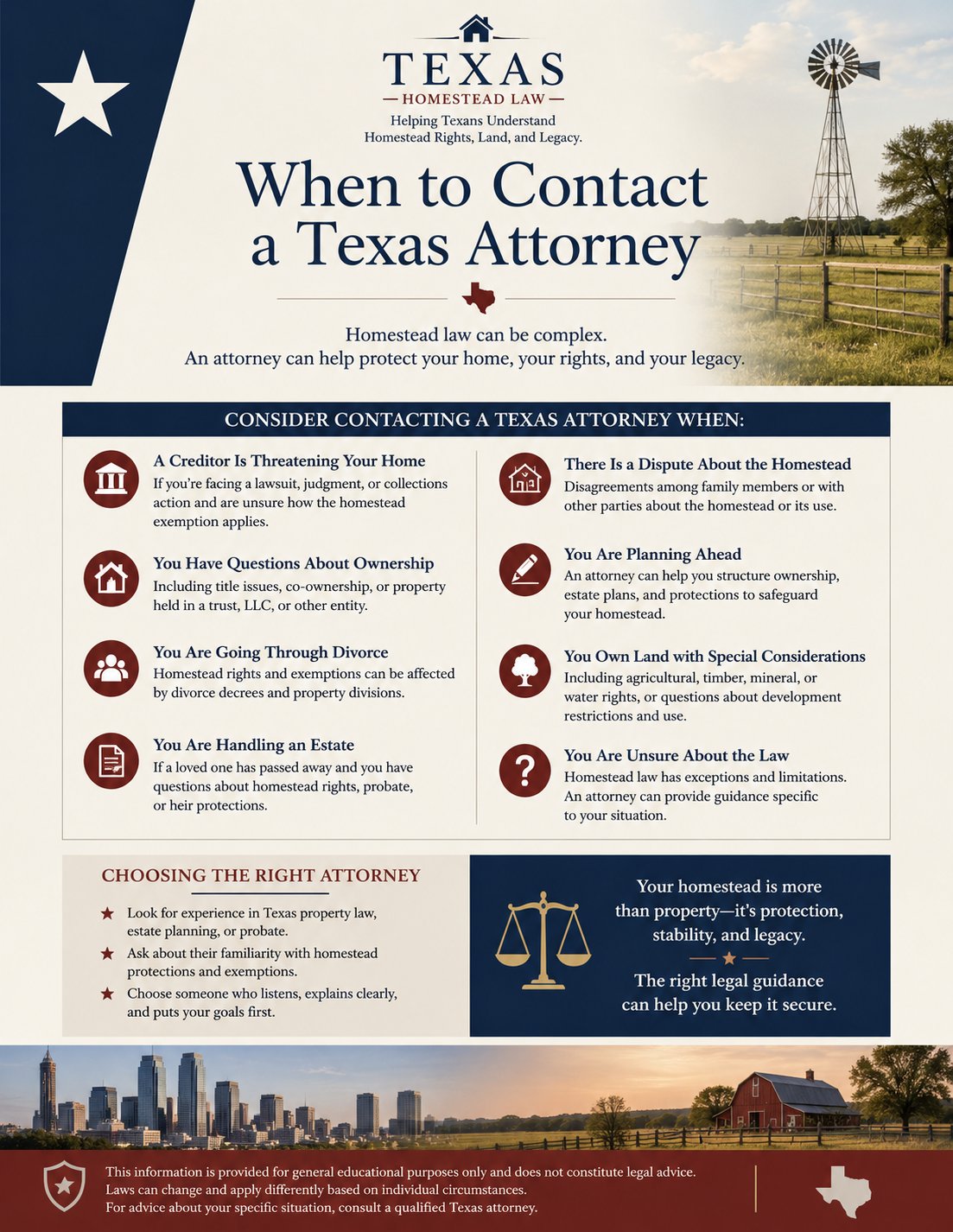
A surviving spouse should consider speaking with a Texas probate, estate, or real estate attorney if there is disagreement over ownership, pressure from heirs, a blended family situation, no will, creditor claims, delinquent taxes, a pending foreclosure, or uncertainty about whether the surviving spouse can remain in the home.
Legal help may also be important if the surviving spouse is trying to transfer title, sell the home, use a small estate affidavit, record an affidavit of heirship, or understand how a will affects the homestead.
The key takeaway
Texas law gives surviving spouses meaningful homestead protections, but those protections depend on the facts. Property tax exemptions are one piece of the picture. The right to remain protected in the home may be another.
After the death of a spouse, the safest first step is to slow down, gather the property records, contact the county appraisal district about exemptions, and seek legal guidance before signing away rights, moving out, or assuming the home must be sold.
Texas homestead law is designed to protect the home, but surviving spouses need clear information to understand what protections apply.
Learn more about how Texas homestead protections may apply after the death of a spouse, including exemptions, probate issues, heirship questions, and when to seek legal help.
Sources & references
The Texas Comptroller explains current residence homestead qualification basics, the additional school exemption for age 65 or older and disabled homeowners, and the surviving-spouse eligibility concept for the age-65 exemption. The Comptroller also summarizes surviving spouse exemptions for 100% disabled veterans, armed services members killed or fatally injured in the line of duty, first responders, and certain qualifying veterans.
Texas Constitution Article XVI, Section 52 addresses descent of the homestead and restrictions on partition after death (Texas Statutes). TexasLawHelp probate materials support the point that small estate affidavits and exempt-property issues can involve the homestead for a surviving spouse or minor child.
Last reviewed June 29, 2026. Laws, exemptions, deadlines, and local practices may change — please verify with official sources and consult a qualified professional about your specific situation.